
Facility Name
External users: registration to be carried out only through I-STEM portal
Additional information about sample and analysis details should be filled in the pdf form provided in the I-STEM portal under “DOWNLOAD CSRF”
Internal users (IITB): registration to be carried out only through DRONA portal
Additional information about sample and analysis details should be filled in the pdf form provided here.
.
Category
- Diffraction » X-ray Diffraction
Booking Details
Facility Management Team and Location
Prof. Subhabrata Dhar
Prof. Aswani Yella
Prof. Shaibal k. Sarkar
Prof. Dipti Gupta
Facility Features, Working Principle and Specifications
Facility Description
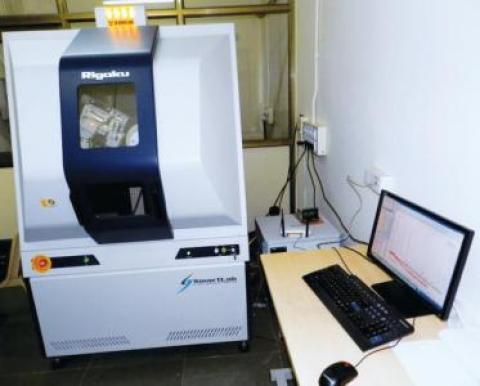
The Rigaku SmartLab is a fully automated multipurpose X-ray diffractometer used for θ–2θ, GIXRD, XRR, and HT-XRD measurements on powder, bulk, and thin-film samples.
Make and Model: Rigaku SmartLab, 3 kW
It has a high-temperature stage (non-functional currently)
- X-Ray reflectivity measurement
- In-situ high temperature XRD measurement (yet to be functional)
- X-ray diffraction (XRD) is an instrumental technique to study crystalline materials. An X-ray beam is focused on the planes of the atoms forming the crystal lattice of the material under study. Of the incident beam, a part is transmitted, a part is absorbed, a part is refracted and scattered while the remaining part is diffracted. On diffraction of the x-ray beam from the sample, the distances between the planes of the atoms constituting the sample can be obtained by applying the Bragg's law. Bragg's law is given as nλ=2d sinθ, where n is the order of the diffracted beam, λ is the wavelength of the incident x-ray, d is the distance between adjacent planes of atoms and θ is the angle of incidence of the x-ray. With known values of λ and θ the d-spacings of the atoms in the sample can be calculated. The characteristic set of d-spacings and theirs intensity generated in a typical X-ray scan provides a unique "fingerprint" of the phases present in the sample. On proper interpretation with comparison with standard references available, the sample material can be identified from the respective "fingerprints" obtained.
- X-Ray reflectivity measurement
- In-situ high temperature XRD measurement
- Maximum rated output: 3 kW
- Rated tube voltage-current: 20-60 kV; 2-60 mA
- Target: Cu
- Focus Size: 0.4 X 12 mm line/point
- Radiation enclosure: Full safety shielding with failsafe open/close mechanism
- Scanning mode: θ-2θ scan, 2θ scan
- Optics: Incidence
- optics: CBO
- Receiving optics: Automatic variable scattering slit PSA
- Detector: Scintillator NaI, Dtex
Sample Preparation, User Instructions and Precautionary Measures
Please follow the sample preparation methods below, according to the nature of your analysis.
For Powder XRD
Finely grained powders should be submitted. Powder samples having a minimum weight of 0.01g can be analyzed.
For Thin Film XRD and GIXRD
Sample size should be minimum 5mm X 5mm.
For High temperature XRD
The powder samples should be mixed with a volatile solvent so as to form slurry. The slurry will then be drop casted on the sample holder.
For XRR
Thin films should be deposited on Si substrates.
Please follow the sample preparation methods below, according to the nature of your analysis.
- For powder XRD, the sample quantity should be finely grained.
- For High temperature XRD analysis, the user should be present during the analysis and the user should bring the necessary requisites to make the slurry out of his powder samples.
- Measurement data will be given in CD format. Please bring your own CD.
- Samples and Measurement data should be collected as soon as the analysis gets completed with a maximum of duration of one week.
Charges for Analytical Services in Different Categories
User Charges
Sr. No. | Category | θ–2θ Scan (₹) | GI-XRD (₹) | GST |
|---|---|---|---|---|
1 | IITB Lab TAs (½X) | 125 | 200 | Nil |
2 | IITB Students (1X) | 250 | 400 | Nil |
3 | IITB Monash Students (1X) | 250 | 400 | 18% |
4 | Academic Institutes (2X) | 500 | - | 18% |
5 | National Laboratories (5X) | 1,000 | - | 18% |
6 | SINE (Letter from SINE required) (5X) | 1,250 | - | 18% |
7 | Research Park (MSME) (Letter from RP required) (5X) | 1,250 | - | 18% |
8 | Research Park (Big Industry Partners) & MSMEs not associated with RP (7.5X) | 1,875 | - | 18% |
9 | Industries (10X) | 2,500 | - | 18% |
Additional Charges
Taxes: Extra (GST @18% wherever applicable).
Standard scan duration: Maximum 15 minutes per sample for θ–2θ scans. Beyond the standard scan duration, additional charges shall apply as below:
Category | Additional Charge (per 15 min/sample beyond standard duration) |
|---|---|
½X | ₹25 per 15 minutes/sample |
1X | ₹50 per 15 minutes/sample |
2X | ₹100 per 15 minutes/sample |
5X | ₹250 per 15 minutes/sample |
7.5X | ₹375 per 15 minutes/sample |
10X | ₹500 per 15 minutes/sample |
No analysis of XRD data will be provided. Users will receive the raw diffraction data on a DVD/CD(User must bring their own CD). No data will be provided on USB sticks/ pen drives.
The above rates may be revised periodically with CSIF approval.
The user must furnish the signed analysis request form and sumbit it along with the samples.
GI-XRD: For external users, these measurements will only be done after checking with and getting approval from the Faculty-in-Charge, depending on the sample and what is needed.
Applications
- Identification of crystalline materials
- Characterization of crystalline materials
- Powder X-ray Diffraction (θ–2θ)
- Grazing Incidence X-ray Diffraction (GI-XRD)
Sample Details
Samples containing chemicals must be non-hazardous and non-toxic and comply with the facility’s safety guidelines
N/A
SOP, Lab Policies and Other Details
Publications
N/A