
Facility Name
External users: registration to be carried out only through I-STEM portal
Additional information about sample and analysis details should be filled in the pdf form provided in the I-STEM portal under “DOWNLOAD CSRF”
Internal users (IITB): registration to be carried out only through DRONA portal
Additional information about sample and analysis details should be filled in the pdf form provided here.
.
Category
- Synthesis » Chemical Synthesis
Booking Details
Facility Management Team and Location
Facility Features, Working Principle and Specifications
Facility Description
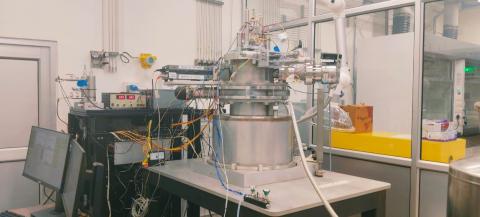
The Transient Analysis of Products (TAP) Reactor is a high-vacuum, pulse-response catalytic reactor designed for the investigation of intrinsic reaction kinetics and mechanisms under transport-free conditions. The system enables the introduction of precisely controlled microsecond to millisecond pulses of reactant gases over a catalyst bed, allowing detailed analysis of transient behavior.
The facility is particularly suited for:
- Identification of active sites and reaction pathways
- Quantification of rate constants and surface intermediates
- Study of catalyst structure–activity relationships
- Investigation of deactivation, poisoning, and promotion effects
Overall, the TAP reactor serves as a state-of-the-art platform for fundamental catalysis research, bridging the pressure and material gap.
The Transient Analysis of Products (TAP) reactor operates under high-vacuum and pulse-response conditions to study intrinsic catalytic kinetics without transport limitations. A small amount of reactant gas is introduced into the reactor as a short pulse (typically milliseconds) over a catalyst bed under Knudsen diffusion conditions. The transient response of reactants and products is monitored using a mass spectrometer at the reactor outlet.
Key principles:
- Knudsen diffusion regime ensures that molecular transport is governed by wall collisions rather than intermolecular interactions.
- Temporal separation of elementary steps allows identification of adsorption, desorption, and surface reaction kinetics.
- The system eliminates heat and mass transfer limitations, enabling extraction of intrinsic kinetic parameters.
- Pulse-response curves are analyzed to determine reaction mechanisms, rate constants, and surface intermediates.
Sample Preparation, User Instructions and Precautionary Measures
- Catalyst samples must be finely powdered (typically 300 –450 µm particle size) to ensure uniform packing and diffusion behavior.
- The sample should be free of moisture and contaminants; pre-drying under vacuum or inert gas is recommended.
- Typical catalyst loading is in the range of 10–30 mg, diluted with inert material (e.g., quartz sand) to maintain Knudsen conditions.
- Avoid agglomeration; ensure homogeneous mixing with inert diluent.
- Use only chemically stable materials that do not decompose under vacuum or experimental temperatures
Charges for Analytical Services in Different Categories
Charges for Internal Users (GST- 18%)
| Description | Cost per sample (3-day experiment) * |
| IITB TAs | ₹ 6000/- |
| Other IITB Users | ₹ 12000/- |
| SINE incubation | ₹ 60000/-+GST |
| Monash-IITB Users | ₹ 12000/-+ GST |
Charges for External Users (GST- 18%):
| Description | Cost per sample (3-day experiment) * |
| Academic | ₹ 24000/-+ GST |
| National R & D Labs | ₹ 60000/+GST |
| Research Park (MSME) | ₹ 60000/+GST |
| Industry/Non-Govt. Agencies | ₹ 120000/-+GST |
| Other Countries (Academic) | ₹ 60000/-+GST |
Applications
- Determination of intrinsic catalytic kinetics under transport-free conditions
- Study of elementary reaction steps (adsorption, desorption, surface reaction)
- Investigation of reaction mechanisms and intermediates
- Quantification of active sites and site utilization
- Analysis of metal-support interactions and catalyst states
- Study of poisoning, promotion, and deactivation mechanisms
- Microkinetic model development and validation