
Facility Name
External users: registration to be carried out only through I-STEM portal
Additional information about sample and analysis details should be filled in the pdf form provided in the I-STEM portal under “DOWNLOAD CSRF”
Internal users (IITB): registration to be carried out only through DRONA portal
Additional information about sample and analysis details should be filled in the pdf form provided here.
.
Category
- Services » Service
Booking Details
Facility Management Team and Location
Facility Features, Working Principle and Specifications
Facility Description
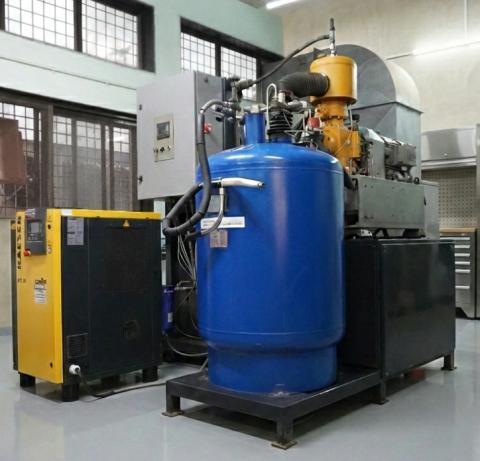
Cryogenic liquid nitrogen generation facility based on air separation technology, capable of producing high-purity LN₂ at −196 °C for research, testing, cryopreservation, and low-temperature engineering applications.
The Stirling Liquid Nitrogen plant is used to produce liquid nitrogen. The nitrogen is separated from compressed ambient air (consisting of 78 % nitrogen) using the Pressure Swing Adsorption (PSA) process. Then the nitrogen gas is liquefied using the cooling effect produced by the cryogenerator. Subsequently, the liquid nitrogen is stored as liquid in a storage container under positive pressure.
Main parts of the Nitrogen plant
- Air compressor
- Air vessel
- Dryer
- Pressure Swing Adsorption system
- Nitrogen Vessel
- Cryogenerator
- Dewar
LN2 Plant – (StirLIN - 1) Production Capacity 10LPH, Refrigeration capacity 4.4 kW@65K
- Chiller Cooling capacity: 12 kW
- Cryo - generator Motor power: 11 kW
- Working gas: Helium, Filling pressure 22 barg@50Hz
- Liquid nitrogen purity >99%
- Air Compressor type: Screw, Compressor Motor power 5.5 kW
- Max Working pressure of air compressor 10 barg
Sample Preparation, User Instructions and Precautionary Measures
Users need to bring LN2 Cryogenic Dewar
Users should follow Cryogenics safety requirements.
Charges for Analytical Services in Different Categories
Category | Internal Academic |
|
LN2 | 12/- | Per litre |
Applications
- Cryopreservation of biological samples and cells
- Low-temperature material property testing
- Cooling of scientific instruments such as NMR and detectors
- Pre-cooling for cryogenic and refrigeration systems
- Superconductivity and low-temperature physics research
- Freeze grinding and sample preparation
- Shrink fitting and thermal assembly of mechanical components
- Inert atmosphere creation for chemical and metallurgical processes
- Educational demonstrations and academic experiments
Sample Details
NA
NA
NA