
Facility Name
External users: registration to be carried out only through I-STEM portal
Additional information about sample and analysis details should be filled in the pdf form provided in the I-STEM portal under “DOWNLOAD CSRF”
Internal users (IITB): registration to be carried out only through DRONA portal
Additional information about sample and analysis details should be filled in the pdf form provided here.
.
Category
- Diffraction » X-ray Diffraction
Booking Details
Facility Management Team and Location
Facility Features, Working Principle and Specifications
Facility Description
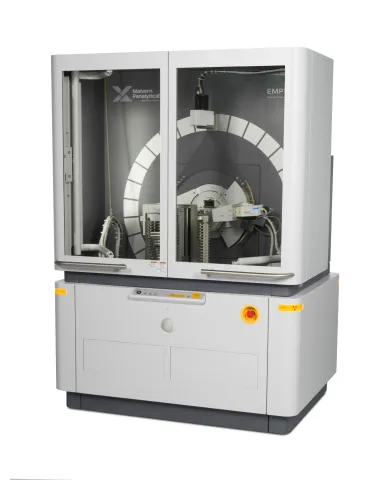
x- ray Diffraction(XRD ) is a versatile non -destructive analytical technique used to analyze physical properties such as phase composition , crystal stucture and orientation of powder solid samples.
Phase identication can be performed by comparing x-ray diffraction patterns obtained from unkmown samples to patterns in reference database.
X-ray Diffraction is the result of constructive interference between x rays and a crystalline sample.
The wavelength of the x-rays used is of the same order of magnitude of the distance between the atoms in a crystalline lattice.
This gives rise to a diffraction pattern that can be analysed by applying the Bragg’s Law (nλ=2dsinθ)which is used in the measurement of crystal and their phases.
X-ray tube: Cu; long fine focus; spinner stage
Pixcel 1D detector with prefix interface
X’pert highscore plus; reflectivity software; easysaxs software
Sample Preparation, User Instructions and Precautionary Measures
Please follow the sample preparation methods below, according to the nature of your analysis.
For Powder XRD
Samples should be submitted in the form of fine powder (preferably less than 10 μm) to completely fill the rectangular cavity of the sample holder of dimension of 0.6 cm3.
i.e. l = 2 cm, b = 1.5cm, h = 0.2 cm.
For Pallet Samples, the sample should have diameter of 2 cm and height 1 cm (maximum).
For Thin Film XRD and GIXRD
Sample size should be minimum 5 cm ´ 2.5 cm.
Charges for Analytical Services in Different Categories
Sr. No. |
Category | Charges |
GST | |
θ-2θ Scan | GI -XRD | |||
1 | IITB (Lab TAs) (X/2) | 125 | 200 | NIL |
2 | IITB Students (X) | 250 | 400 | NIL |
3 | IITB Monash Students (X) | 250 | 400 | 18% |
4 | Academic Institutes (2X) | 500 | - | 18% |
5 | National Lab (5X) | 1000 | - | 18% |
6 | Sine (letter from SINE reqd.) (5X) | 1250 | - | 18% |
7 | Research Park (MSME) (5X) (letter from RP reqd.) | 1250 | - | 18% |
8 | Research Park (Big Industry Partners) (Letter from RP reqd.) & MSME not associated with RP (7.5X) (appropriate certificate reqd.) |
1875 |
- |
18% |
9 | Industries (10X) | 2500 | - | 18% |
(i) Taxes : EXTRA (At present GST @ 18%)
(ii) Scan duration: Maximum 15 minutes per sample; Beyond this, extra @Rs 25/15 min/sample for X/2; Rs 50/15 min/sample for X; Rs 100/15 min/sample for 2X; Rs 250/15 min/sample for 5X; Rs 375/15 min/sample for 7.5X; Rs 500/15 min/sample for 10X;
(iii) No analysis will be done on the XRD data and it is user's responsibility.
(iv) The above rates may be revised once in six months
Applications
- Phase Identification of unknown crystalline materials.
- Characterization of crystalline materials.
- Determination of crystal structures using Rietveld refinement.
- Thin film characterization.
- Complete Functional system for Phase Analysis & Crystallography.
Thin film attachment (GIXRD) & reflectivity measurements.