
Facility Name
External users: registration to be carried out only through I-STEM portal
Additional information about sample and analysis details should be filled in the pdf form provided in the I-STEM portal under “DOWNLOAD CSRF”
Internal users (IITB): registration to be carried out only through DRONA portal
Additional information about sample and analysis details should be filled in the pdf form provided here.
.
Category
- Diffraction » X-ray Diffraction
Booking Details
Facility Management Team and Location
Facility Features, Working Principle and Specifications
Facility Description
X-ray diffraction has long been the primary tool for identifying phases and determining the structures of mostly crystalline inorganic materials. It remains the most crucial material characterization technique today. With the advent of nanomaterials, XRD has been extended to measure particle size, orientation, lattice distortions, and more. Typically, XRD is the first characterization method used after synthesis to verify if the desired material has been obtained.
Make and Model
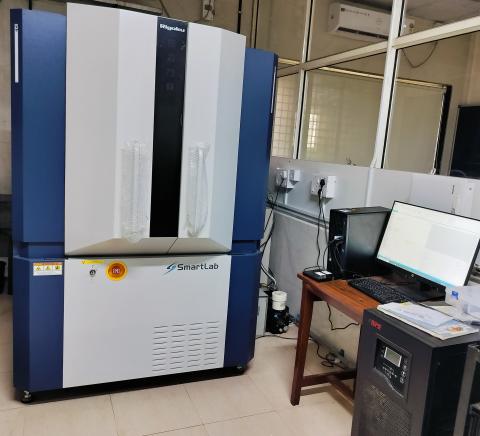
Rigaku SmartlabSE
The present model is also equipped with two stages:
- High-temperature stage - The High-Temperature Attachment (HT-XRD) can operate from ambient temperature up to 1500°C in air, up to 1450°C in a vacuum, and up to 1300°C in an inert gas.
- (OPERATIONAL)
- Electrochemical stage - An electrochemical stage with electrical feedthrough through the X-ray chamber and potentiostat for in-situ analysis for aqueous electrochemistry applications only. (NOT YET OPERATIONAL).
The X-Ray Diffraction System SmartLab SE includes the SmartLab SE Goniometer with a scanning radius of 300 mm (diameter 600 mm) and a 3 kW sealed ceramic Cu X-ray tube. The maximum tube voltage is 60 kV, and the maximum tube current is 60 mA. The DTex 250 sensor is a semiconductor strip sensor with an active area of 384 mm² (19.2 x 20 mm). The system features an automatic slit exchanger with alignment and control, along with automatic systematic error correction. The solar slits are available in 2.5 degrees and 5 degrees for the incident and diffracted beams, respectively, and are easily interchangeable. Additionally, the system includes a Ni filter. The minimum step angle is 0.0001 degrees, and the scanning angle range is -10 to +160 degrees in 2 theta.
The enclosed cabinet has doors designed for easy access and adheres to regulations for X-ray, electrical, and mechanical safety. Additionally, the system includes Data Collector software, which provides functionalities such as data acquisition in an appropriate format, tools for determining measurement strategies, configuration and measurement management, automatic processing, and data conversion and viewing capabilities for X-ray diffraction systems.
The High-Temperature Attachment (HT-XRD) can operate from ambient temperature up to 1500°C in air, up to 1450°C in a vacuum, and up to 1300°C in an inert gas. It is equipped with a JIS Type (2) thermocouple. The sample size is 13.5 x 25 x 0.5 mm. The HT-XRD attachment can only run once in a day.
- For powdered samples: Bragg -Brentano optics (Conventional divergent beam)
- High-temperature stage - Sample heating stages capable of heating from ambient to 1500C in inert or vacuum with suitable software to collect XRD scans at intermittent temperature. (OPERATIONAL)
- Electrochemical stage - An electrochemical stage with electrical feedthrough through the X-ray chamber and potentiostat for in-situ analysis for aqueous electrochemistry applications only.
Sample Preparation, User Instructions and Precautionary Measures
For powdered samples: kindly submit completely dried and powdered non hazardous samples only. For thin/thick films: the sample dimensions should not be more than 1cm x 1cm.
Charges for Analytical Services in Different Categories
Charges (per sample) for IITB students (X)
(Routine scan = ₹250 for a scan range of 60 in 2θ at 4° in 2θ/minute, equivalent to a 15-minute scan):
| Scan Range in 2θ ↓ | Scan Rate in 2θ/min→ | 0.2 | 0.4 | 0.5 | 0.6 | 0.8 | 1 | 2 | 4 | 5 | 6 | 8 | 10 |
|---|---|---|---|---|---|---|---|---|---|---|---|---|---|
| 10 | 367.00 | 284.00 | 267.00 | 256.00 | 250.00 | 250.00 | 250.00 | 250.00 | 250.00 | 250.00 | 250.00 | 250.00 | |
| 20 | 534.00 | 367.00 | 334.00 | 311.00 | 284.00 | 267.00 | 250.00 | 250.00 | 250.00 | 250.00 | 250.00 | 250.00 | |
| 30 | 700.00 | 450.00 | 400.00 | 367.00 | 325.00 | 300.00 | 250.00 | 250.00 | 250.00 | 250.00 | 250.00 | 250.00 | |
| 40 | 867.00 | 534.00 | 467.00 | 423.00 | 367.00 | 334.00 | 267.00 | 250.00 | 250.00 | 250.00 | 250.00 | 250.00 | |
| 50 | 1034.00 | 617.00 | 534.00 | 478.00 | 409.00 | 367.00 | 284.00 | 250.00 | 250.00 | 250.00 | 250.00 | 250.00 | |
| 60 | 1200.00 | 700.00 | 600.00 | 534.00 | 450.00 | 400.00 | 300.00 | 250.00 | 250.00 | 250.00 | 250.00 | 250.00 | |
| 70 | 1367.00 | 784.00 | 667.00 | 589.00 | 492.00 | 434.00 | 317.00 | 259.00 | 250.00 | 250.00 | 250.00 | 250.00 | |
| 80 | 1534.00 | 867.00 | 734.00 | 645.00 | 534.00 | 467.00 | 334.00 | 267.00 | 254.00 | 250.00 | 250.00 | 250.00 | |
| 90 | 1700.00 | 950.00 | 800.00 | 700.00 | 575.00 | 500.00 | 350.00 | 275.00 | 260.00 | 250.00 | 250.00 | 250.00 |
Note: Minimum charge for X = ₹250 per sample, plus ₹50 per additional 15 minutes.
Routine Scan Charge per minute
| Routine Scan | Charge per minute | ||
|---|---|---|---|
| IITB (TA) | X/2 | 125 | 8.33 |
| IITB Students | X | 250 | 16.67 |
| IITB Monash Students | X + 18% GST | 295 | 19.67 |
| Academic Institutes | 2X + 18% GST | 590 | 39.33 |
| National Labs | 5X + 18% GST | 1,475 | 98.33 |
| SINE (Letter from SINE reqd.) | 5X + 18% GST | 1,475 | 98.33 |
| Research Park (MSME) (Letter from RP reqd.) | 5X + 18% GST | 1,475 | 98.33 |
| Research Park (Big industry partner) (letter from RP required) and MSME not associated with RP (appropriate certificate required) | 7.5X + 18% GST | 2,212.50 | 147.50 |
| Industries | 10X + 18% GST | 2,950 | 196.67 |
*Routine scan is a scan with a scan range of 60 in 2θ at 4° in 2θ per minute
Rules and guidelines
- The charges will be based on the Charge table (minimum ₹ 250/- for IITB Students (X) per sample) provided below.
- No analysis will be done on the XRD data. The user will be provided with the XY data in ASCII/CSV format on a DVD/CD (to be provided by the user). No data will be provided on USB sticks/ pen drives.
- The user must furnish the signed analysis request form (provided below) and submit it along with the samples.
- Only powdered samples will be accepted. For foils/films, send a request to the faculty in charge of the facility via email.
- At a time, no more than 5 samples will be accepted per user.
- The rates may be revised every 6 months.
The facility will run on working days from 10:00 am to 5:00 pm.
For High-Temperature XRD (HT-XRD)
- The charges are based on both the instrument usage time and the requested temperature(s). It takes almost a full day to analyze 1 sample. The HT-XRD will be limited to 1000 °C.
- A base charge of ₹1,700 (for X) applies, which includes two routine scans: one at room temperature and one at a single user-specified temperature.
- If scans are required at additional temperatures, extra charges will be levied for each additional temperature according to the applicable rate table. These charges are in addition to the base charge of ₹1,700.
Example for X (IITB Student): (For other users, applicable charges, as per the table, apply.)
Charges for routine scan at 500 °C = ₹ 1700.00 (Includes 1 routine scan at room temperature and another routine scan at 500 °C)
Charge for 2 routine scans at 500 °C and 700 °C = ₹ 1700.00 + ₹ 250.00 = ₹ 1950.00 (Includes 1 routine scan at room temperature, a routine scan at 500 °C, and another routine scan at 700 °C)
Charge for 1 routine scan at 500 °C and another scan range of 80 and scan rate of 1 at 700 °C = ₹ 1700.00 + ₹ 400.00 = ₹ 2100.00 (Includes 1 routine scan at room temperature, routine scan at 500 °C and another user-specified scan at 700 °C)
Applications
- Identification of unknown crystalline materials
- Characterization of crystalline materials
- Determination of crystal structures