
Facility Name
External users: registration to be carried out only through I-STEM portal
Additional information about sample and analysis details should be filled in the pdf form provided in the I-STEM portal under “DOWNLOAD CSRF”
Internal users (IITB): registration to be carried out only through DRONA portal
Additional information about sample and analysis details should be filled in the pdf form provided here.
.
Category
- Material Characterization » Thermal Characterisation
Booking Details
Rate of temperature: 10°C /Min to 20°C/Min.
Gas: Nitrogen/Zero Air.
Sample Form: Powder
Facility Management Team and Location
email ID:- tga.chem@csif.iitb.ac.in
Prof. Sanjog Nagarkar.
Prof. Srinivasan Ramakrishnan.
Prof. Guruswamy Kumaraswamy.
Prof . Narendra Sudhir Shiradkar.
Facility Features, Working Principle and Specifications
Facility Description
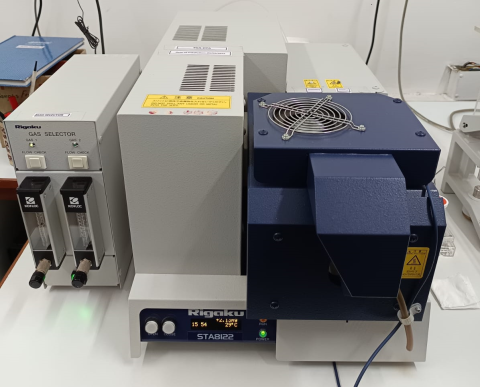
The Thermo Gravimetric Analyzer (TGA) measures a sample's change in weight as a function of temperature, enabling detailed analysis of reactions such as dehydration, thermal decomposition, evaporation, and oxidation. Additionally, Differential Thermal Analysis (DTA) detects endothermic and exothermic reactions during phase transitions, melting, crystallization, decomposition, and glass transition temperatures.
Rigaku’s TGA utilizes a horizontal differential triple-coil balance, designed to cancel out fluctuations and ensure highly accurate weight change measurements, providing robust data for thermal analysis.
In thermogravimetry, measuring the sample’s change in weight enables us to analyze the reaction temperature and the rate of weight change in reactions such as dehydration, thermal decomposition, evaporation, oxidation. Differential thermal analysis (DTA) measures the endothermic or exothermic reaction temperatures such in transition, melting, crystallization, dehydration, decomposition, oxidation and glass transition temperature.
Model: TGA-STA8122
Analysis Range: RT to 1000 °C
Heating Rate: 10 °C/min to 20 °C/min
Gas: Nitrogen / Zero Air
Sample Form: Powder
Technique: TGA-DTA (Thermogravimetric Analysis – Differential Thermal Analysis)
Sample Preparation, User Instructions and Precautionary Measures
- At least 20 mg of sample should be submitted.
- Sample size should be < 5mm in diameter and < 2.5mm in thickness.
- Samples containing halogens should not be sent and will not be accepted for analysis.
- Samples containing corrosive substances that will react with Aluminium/Platinum/Ceramic pans should not be sent for analysis by TG-DTA.
- Samples should not be toxic or hazardous.
- Radioactive material, unstable and explosive compounds are not accepted for analysis.
- Interpretation of spectra is NOT undertaken.
- Samples containing alkali metal oxides, hydroxides, heavy metals, alkali metal halides, nitrates, or large amounts of sulphur heated in a platinum crucible can erode the crucible.
- If heavy metals like lead, bismuth, tin, arsenic, silver, mercury, copper, Selenium, tellurium, etc. are present then do specify them in sample information form.
Charges for Analytical Services in Different Categories
| IITB (TAs) | IITB Students | IITB-Monash Students | Academic Institutes | National Labs | Sine (letter from SINE reqd.) | Research Park (MSME) (letter from RP reqd.) | Research Park (Big Industry partners) (letter from RP reqd.) | and MSME not associated with RP (appropriate certificate required) | Industries | |
| Charges | X/2 | X | X | 2X | 5X | 5X | 5X | 7.5X | 7.5X | 10X |
| For standard measurement RT-500°C @10°C/min | 65 | 130 | 130 | 260 | 650 | 650 | 650 | 975 | 975 | 1300 |
| For measurement >500°C @10°C/min for a sample per hour | 130 | 260 | 260 | 520 | 1300 | 1300 | 1300 | 1950 | 1950 | 2600 |
| GST | NO GST | NO GST | 18 % GST | 18 % GST | 18 % GST | 18 % GST | 18 % GST | 18 % GST | 18 % GST | 18 % GST |
NOTE: - For Thermal Analysis, standard ramp is 10 ℃/min. Heating rates less than standard rate will be charged double.
Applications
1. Thermal Stability Analysis: Determines thermal stability and decomposition temperatures of materials.
2. Moisture and Volatile Content: Measures mass loss due to moisture, volatile substances and thermal decomposition.
3. Phase Transition Analysis: Identifies endothermic and exothermic events, including melting and crystallization.
4. Material Characterization: Evaluates the thermal behaviour of polymers, pharmaceuticals, catalysts and inorganic materials.
5. Oxidation and Decomposition Studies: Investigates oxidation behaviour, thermal degradation and decomposition mechanisms under controlled atmospheres.
Sample Details
Non explosive and non-corrosive
N2 and Zero Air
Powder form.
Sample should be in pure form
SOP, Lab Policies and Other Details
Publications
1. Engineering Amorphous Cobalt–Nickel Phosphate Nanostructures on Exfoliated Graphite: A Molecular Precursor-Driven Route to High-Performance Alkaline Water Splitting Catalysts
Savi Chaudhary, Meera P. Reghunath, Vanita Madhukar Mohite, Anil Kumar, Ramaswamy Murugavel
https://doi.org/10.1002/smll.202508598Digital Object Identifier (DOI)
2. Unraveling an Organic Soluble Precursor-Based Low-Temperature Synthetic Strategy to Impurity-Free Pristine and Transition Metal Doped Lead Apatites
Meera P Reghunath, Ramaswamy Murugavel
https://doi.org/10.1002/chem.202501888Digital Object Identifier (DOI)
3. Acousto-Electric Conversion by the Piezoelectric Nanogenerator of a Molecular Copper (II) Complex
Rajashi Haldar, Sudip Naskar, Bidya Mondal, Asif Iqbal, Ranjit Thapa, Dipankar Mandal, Maheswaran Shanmugam
https://doi.org/10.1002/adma.202504086
4. Harnessing thermal waste with a poling-free molecular pyroelectric zinc(ii) complex
Rajashi Haldar, Sudip Naskar, Bapan Jana, Dipankar Mandal, Maheswaran Shanmugam
https://doi.org/10.1039/D4CC06054G
5. Co(ii) complex promoted PVDF β-phase crystallization: innovations in pressure sensing and energy harvesting
Bapan Jana,a Shewli Pratihar, b Rajashi Haldar,a Akash M. Chandran,b Dipanti Borah,a Prasanna Kumar S Mural*b and Maheswaran Shanmugam
https://doi.org/10.1039/D5TA01701G