
Facility Name
External users: registration to be carried out only through I-STEM portal
Additional information about sample and analysis details should be filled in the pdf form provided in the I-STEM portal under “DOWNLOAD CSRF”
Internal users (IITB): registration to be carried out only through DRONA portal
Additional information about sample and analysis details should be filled in the pdf form provided here.
.
Category
- Material Characterization » Electrical Characterisation
Booking Details
Low temperature mode
Facility Management Team and Location
bala.ramanathan@iitb.ac.in
022 - 2576-7808
Prof. R O Dusane
Prof. Subhananda Chakrabarti
Prof. Subhabrata Dhar
Facility Features, Working Principle and Specifications
Facility Description
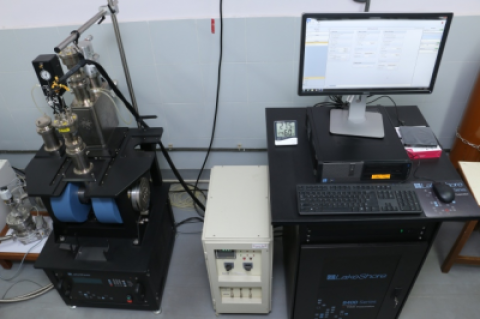
The Variable Temperature Hall Measurement Facility (Lake Shore 8404 Series) is available for characterization of electrical transport properties under controlled temperature and magnetic field conditions.
The facility supports measurements such as Hall Effect, resistivity, carrier concentration, carrier mobility, and temperature-dependent electrical properties of thin films, semiconductor materials, nanomaterials, and bulk samples.
The Variable Temperature Hall Measurement System works on the principle of the Hall Effect and electrical resistivity measurement.
When a current-carrying sample is placed in a magnetic field perpendicular to the direction of current flow, a transverse voltage known as the Hall voltage is developed across the sample due to the deflection of charge carriers. The measured Hall voltage is used to determine carrier concentration, carrier mobility, and carrier type.
- The versatile Hall Measurement System employs an AC magnetic field for measuring low mobilities down to 0.001 cm2/V.s, much lower than ever possible using traditional DC field Hall measurement techniques.
- The system also has an unusually high resistance option to measure samples with resistance as high as 200 GΩ in van der Pauw geometry.
- Measurement of low mobilities down to 0.001 cm2/v.s, much lower than ever possible using traditional DC field hall measurement techniques.
- High resistance option to measure samples with resistance as high as 200GΩ in van der Pauw geometry.
- LakeShore Model 8404 AC/DC Hall Effect Measurement System (HMS) can provide a full range of Hall measurements using van der Pauw or Hall probe sample geometries. Options include high resistance and low resistance samples, low mobility samples and variable temperature measurement.
- DC Field measurements :
Resistance range: 0.5 mΩ to 200 GΩ - AC Field measurements :
Capable of measuring mobility's down to 0.001 cm2/V. - Low temperature option :
Variable Temperature assembly (temperature range 15 K to 350 K)
Sample Preparation, User Instructions and Precautionary Measures
It is desirable to have samples of approximate size (8 mm x 8 mm) and thickness 1- 2 mm. Any sample shape is acceptable but the minimum and maximum size should be 5 mm and 15 mm, respectively.
Please note that the HMS Facility provides only indium soldering and conductive silver paint for van der pauw contacts to the samples.
For the first time measurement on a pellet type or solution casted samples, the user must contact the HMS Technical Staff (hms@iitb.ac.in), before registering for a slot. The user should fix up a mutually convenient time to check if it is possible to make point contacts with the available facilities. In case it is not possible to make such point contacts, it will be the responsibility of the user to come prepared for a HMS slot, with four van der pauw contacts of ~ 1 mm size at the periphery of the sample, using suitable metals, like, aluminium or gold, etc., which make ohmic contact to their material.
- To help minimize virus-related issues, USB drives are not permitted for data transfer. Kindly bring a blank CD for collecting your data.
- Users are requested to remain present for the entire duration of their slot.
Charges for Analytical Services in Different Categories
For Internal User:
Rs. 300 per slot (3 Hours) for internal users. Please note that low temperature measurements run for longer duration and will be pro-rated as per above charges.
For External Users:
Charges per sample (maximum time 1 hour)
Industry: Rs. 3,000/- *
National labs/R&D Institutions: Rs. 2,000/-*
University/Academic Institutions: Rs. 500/-* (*GST extra)
For samples requiring more than one hour of analysis, there will be 50% extra charge per hour.
Applications
- The 8400 Series HMS combines the best of both DC and AC field Hall measurement methodologies to facilitate the broadest range of research applications. Optional variable temperature modules and measurement platforms extend the utility HMS to meet the specific needs for a large variety of applications.
- Solar cells: OPVs, a: Si, μ-Si, CdTe, CuInGaSe (CIGS)
- Organic electronics: OTFTs, Pentacene, Chalcogenides, OLED
- Transparent conducting oxides: InSnO (ITO), ZnO, GaZnO, InGaZnO (IGZO)
- III-V semiconductors: InP, InSb, InAs, GaN, GaP, GaSb, AIN based devices, high electron mobility transistors (HEMTs) and heterojunction bipolar transistors
- II-VI semiconductors: CdS, CdSe, ZnS, ZnSe, ZnTe, HgCdTe
- Elemental semiconductors: Ge, Si on insulator devices (SOI), SiC, doped diamond SiGe based devices: HBTs and FETs
- Dilute magnetic semiconductors: LGaMnAs, MnZnO
- Other conducting materials: Metal oxides, Organic and inorganic conductors
- High temperature superconductors
Sample Details
SOP, Lab Policies and Other Details
Publications
1.Shravan K Appani, Ashok Kumar Yadav, DS Sutar, SN Jha, D Bhattacharyya, and S S Major,“X-ray absorption spectroscopy study of Ga-doping in reactively sputtered ZnO films”, Thin Solid Films 701, 137966 (2020).
2.Mohammad Monish, Shyam Mohan, D S Sutar, and S S Major, “Gallium nitride films of high n-type conductivity grown by reactive sputtering” Semicond. Sci. Technol. 35, 045011 (2020).
3.Kumar Akash, Sandeep Maurya, Sushobhita Chawla, Suren Patwardhan, and Balasubramaniam Kavaipatti. "Effect of thickness on metal to semiconductor transition in La doped BaSnO3 films deposited on high mismatch LSAT substrates." Applied Physics Letters 114 (21): 212103 (2019).
4.Aggarwal Garima, Sandeep Kumar Maurya, Akhilender Jeet Singh, Ashish K. Singh, and Balasubramaniam Kavaipatti. "Intrinsic Acceptor-like Defects and Their Effect on Carrier Transport in Polycrystalline Cu2O Photocathodes." The Journal of Physical Chemistry C 123 (43): 26057-26064 (2019).
5.Bera Bapi, Divya Priyadarshani, Miji E. Joy, Anand Kumar Tripathi, Sandeep Kumar Maurya, Balasubramaniam Kavaipatti, and Manoj Neergat. "Origin of the Catalytic Activity Improvement of Electrochemically Treated Carbon: An Electrical and Electrochemical Investigation." The Journal of Physical Chemistry C 123 (39): 23773-23782 (2019).
6.Aggarwal Garima, Ashish K. Singh, Sandeep K. Maurya, and K. R. Balasubramaniam. "Copper Oxide Phase Change During Pulsed Laser Deposition of SrTiO3." Advances in Energy Research Springer, Singapore (1): 191-197 (2020).
7.Keshav Prasad Dabral and Satish Vitta, “p-type high temperature thermoelectric behavior of Dy filled CoSb3 and Fe1.5Co2.5Sb12 and their magnetic properties”, ACS Applied Energy Materials (2020).
8.Aditya Dutt, Mofasser Mallick and Satish Vitta, “Enhancing the high temperature thermoelectric performance of Li(CoNi)O2 by replacement of Ni with earth abundant Mg” Journal of Electronic Materials 49 4324 (2020).
9.Keshav Drabral and Satish Vitta, “Tuning the nature of charge carriers by controlling dual substitution in single filled thermoelectric skutterudite, Yb-CoSb3”, Emergent Materials 3 195 (2020).
10.Mofasser Mallick and Satish Vitta, “Effect of double doping, Li and Se, on the high temperature thermoelectric properties of Cu2Te” Journal of Materials Science: Materials in Electronics 31 4129 (2020).
11.Kalpna Rajput and Satish Vitta, “Effect of trivalent rare earth, Dy3+ substitution for Ba2+ on the low temperature magnetic and high temperature thermoelectric properties of type-I Clathrate, Ba8Al16Si30” ACS Applied Energy Materials 2, 6 4255 (2019).
12.Strain-induced variation of bandgap in (111) In2O3 epitaxial films grown on c-sapphire substrates by a pulsed laser deposition technique”, S. K. Yadav, S.Arora, S. Dhar, Semicond. Sci. Technol. 36 (2021) 035011.
13.“X- ray absorption study of defects in reactively sputtered GaN films displaying large variation of conductivity”, Md. Monish, C Nayak, D S Sutar, S N Jha, D Bhattacharyya,S S Major, Semicond. Sci. Technol. 36, 075019 (2021).
14.“X-ray absorption study of defects in reactively sputtered GaN films displaying large variation of conductivity”, M. Monish, C. Nayak, D. S. Sutar, S. N. Jha, D. Bhattacharyya, S. S. Major, Semicond. Sci. Technol., 36(2021), 075019.
15.“A large area flexible p-type transparent conducting CuS ultrathin films generated at liquid-liquid interface”, S. S. Pathak, L. S. Panchakarla, Applied Materials Today, 24(2021), 101152.
16.“Structural, electrical and luminescence properties of (0001) ZnO epitaxial layers grown on c-GaN/sapphire templates by pulsed laser deposition technique”, Simran, S.K. Yadav, S. Dhar, J. Appl. Phys., 131(2022), 015302.
17.M. Mishra, R Saha, L. Tyagi, S. Sushama, S.K. panday, S. Chakrabarti, “Investigation of phosphorus-doping of MgZnO thin films using efficient spin-on dopant process”, Journal of luminescence, 257, 119748 (2023).
18.M. Mishra, S Bhowmick, R Saha, SK Pandey, S Chakrabarti, “Temperature induced conductivity reversal in ZnO thin films”, Proc. SPIE 12422, Oxide-based Materials and Devices XIV, 124220S (2023).
19.P. Mondal & S.S. Major, “Dependence of diode behaviour and photoresponse of Ga-doped ZnO (GZO)/p-Si junction on the carrier concentration of GZO layer”, Micro and Nanostructure 185, 207719 (2024).
20.M. Monish & S.S. Major, “Electrical transport in epitaxially grown undoped and Si-doped degenerate GaN films”, Phys. Scr. 99, 025982 (2024).
21.M. Monish & S.S. Major, “Mg incorporation induced microstructural evolution of reactively sputtered GaN epitaxial films to Mg-doped GaN nanorods”, Nanotechnology 35, 225603 (2024).