
Facility Name
External users: registration to be carried out only through I-STEM portal
Additional information about sample and analysis details should be filled in the pdf form provided in the I-STEM portal under “DOWNLOAD CSRF”
Internal users (IITB): registration to be carried out only through DRONA portal
Additional information about sample and analysis details should be filled in the pdf form provided here.
.
Category
- Material Characterization » Thermal Characterisation
Booking Details
Measurement Method:-Heat Flux
Temperature Range:-(-150C to 725C)
Scanning Rate:-0.1 to 100C
Gas Type:-N2,Air,Ar,O2
Gas Flow Rates:-50 to 500 ml/m
Facility Management Team and Location
Facility Features, Working Principle and Specifications
Facility Description
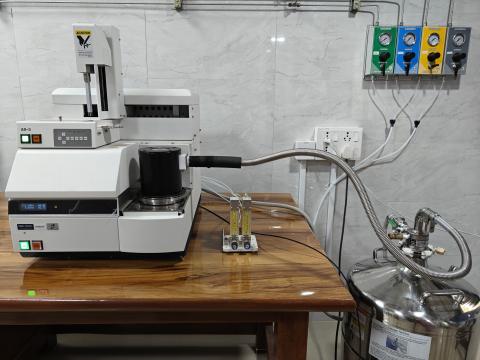
Heat Flux DSC
A technique in which the sample and reference crucible are heated uniformly (under the same conditions) with a definite amount of heat. The difference in temperature between the sample and the reference material gives the heat capacity of the sample and is measured as a function of time and temperature.
DSC is a thermal analytical technique that looks at how a material’s heat capacity (Cp) is changed by temperature. It measures the amount of heat released or absorbed by a material and hence DSC enables the measurements of the transition such as the glass transition, melting, and crystallization.
Measurement Method:-Heat Flux
Temperature Range:-(-150C to 725C)
Scanning Rate:-0.1 to 100C
Gas Type:-N2, Air, Ar, O2
Gas Flow Rates:-50 to 500 ml/min
Sample Preparation, User Instructions and Precautionary Measures
- At least 30-40 mg of sample should be submitted.
- Sample size should be < 5mm in diameter and < 2.5mm in thickness.
- Samples containing halogens should not be sent and will not be accepted for analysis.
- Samples should not be toxic or hazardous.
- Heating program should be less than the decomposition temperature.
Samples containing corrosive substances that will react with Aluminium/Platinum/Ceramic pans should not be sent for analysis by DSC.
Charges for Analytical Services in Different Categories
| IITB User
| IITB Monash
| Academic Institutes
| National Lab/R&D's; Sine (Letter from SINE required); Research Park (MSME) (Letter from RP required)
| Start-Up /MSME/ Research park - Big Industry
| Industry
|
| (No GST) | (Plus 18% GST) | (Plus 18% GST) | (Plus 18% GST) | (Plus 18% GST) | (Plus 18% GST) | |
Heating Program: Temp. Range @ 10 ℃/min |
|
|
|
|
|
|
RT- <400 ℃ | 350 | 350 | 700 | 2100 | 2625 | 3500 |
RT- <600 ℃ | 400 | 400 | 800 | 2400 | 3000 | 4000 |
RT- 700 ℃ | 450 | 450 | 900 | 2700 | 3375 | 4500 |
Low Temp. -80 to 25 ℃ (RT) | 400 | 400 | 800 | 2400 | 3000 | 4000 |
Low Temp. -150 to 25 ℃ (RT) | 800 | 800 | 1600 | 4800 | 6000 | 8000 |
Cp Measurement (RT- 400 @ 4 ℃/min) | 1800 | 1800 | 3600 | 9000 | 7875 | 18000 |
Applications
Glass Transition temperature
Melting and Crystallization temperature
Percent Crystallinities
Compositional analysis of blends
Thermal histories
Thermal denaturation for proteins
Purity Determination
Polymorphism
Drug Compatibility studies, etc.
Sample Details
Non-explosive, non-corrosive, non-toxic, halogen-free, non-carcinogenic.
N.A.
N.A.
Powder, liquid or solids with less than 2.5mm width and length, whereas height less than 1mm.
N.A.
N.A.