
Facility Name
External users: registration to be carried out only through I-STEM portal
Additional information about sample and analysis details should be filled in the pdf form provided in the I-STEM portal under “DOWNLOAD CSRF”
Internal users (IITB): registration to be carried out only through DRONA portal
Additional information about sample and analysis details should be filled in the pdf form provided here.
.
Category
- Spectroscopy and Spectrometry » ESR Spectroscopy
Booking Details
Facility Management Team and Location
office.saif@iitb.ac.in
0091-22- 2576 7691/2
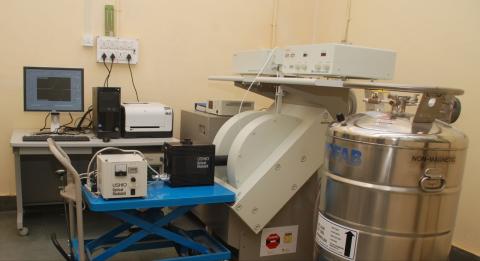
Facility Features, Working Principle and Specifications
Specifications
- EStandard Frequency (X band) - 8.75-9.65 GHz
- Sensitivity - 7x10⁹ spins/0.1mT
- Resolution - 2.35(micro)T or better
- Temperature study - Any temp. from +200oC to liquid nitrogen temp.
- Available accessories :
- Aqueous cell
- Sample Angular Rotation device
- Electrochemical cell
- UV irradiation
- sample mixing cell
Electron Spin resonance spectroscopy is based on the absorption of microwave radiation by an unpaired electron when it is exposed to a strong magnetic field. Species that contain unpaired electrons (namely free radicals, odd-electron molecules, transition metal complexes, rare earth ions, etc.) can therefore be detected by ESR.
Working Principle
When an atomic or molecular system with unpaired electrons is subjected to a magnetic field, the electronic energy levels of the atom or molecule will split into different levels. The magnitude of the splitting is dependent on the strength of the applied magnetic field. The atom or molecule can be excited from one split level to another in the presence of an external radiation of frequency corresponding to the frequency obtained from the difference in energy between the split levels. Such an excitation is called a magnetic resonance absorption. The atom or molecule under investigation may be in different environments in an actual sample. The magnetic resonance frequency will hence be influenced by the local environment of the atom or molecule. The electron spin resonance technique is therefore, a probe for a detailed identification of the various atomic and molecular systems and their environments and all associated parameters.
Sample Preparation, User Instructions and Precautionary Measures
1. Clearly mention state the mode (X-Band/Q-Band) of ESR Spectormeter for your sample analysis.
2. Analysis charges would vary depending on mode selection. Relevent charges are given under each mode.
3. Clearly state the type of analysis required.
Powder/Solution and also RT/77K For solution sample suggest name of solvent.
4. Experiments can be carried out at ambient temperature, liquid nitrogen temperature and most of the temperatures between liquid nitrogen temperature and 200o C.
5. Experiments can be carried out with samples in liquid and solid which includes single crystals, metal alloys, liquid crystals, organic radicals, polymers, glasses, powders, triplets, polyradicals, conduction electrons, drugs, rare-earths, enzymes and proteins.
6. Provide minimum 5-10 mg of solid sample in powder form.
7. Provide minimum 2-3 ml of liquid sample
Charges for Analytical Services in Different Categories
| IIT Bombay Users | IITB-Monash Students
| University/ Academic Institutes
| National Labs/Sine /Research Park IITB (MSME) * Letter from RP Reqd.)
| IITB Research Park (Big Industries) / Start-up/MSME (Letter from Research Park/Start-up/MSME required)
| Industry
|
| |
No GST | + GST @ 18% | + GST @ 18% | + GST @ 18% | + GST @ 18% | + GST @ 18% |
| ||
X-Band Standard Frequency (X band) - 8.75-9.65 GHz | Room Temperature (RT) | 190 | 190 | 380 | 950 | 1425 | 1900 | Per Sample |
Liquid Nitrogen(77K) Additional Rs. 100/ -charges @LN2 Temperature Experiment for external users only | 250 | 250 | 500 | 1250 | 1875 | 2500 | Per Sample | |
Variable Temperature -170o C to +200o C(Charges per degree Celsius) Additional Rs. 100/ -charges @LN2 Temperature Experiment for external users only | 250 | 250 | 500 | 1250 | 1875 | 2500 | Charges per each variable temperature | |
Single crystals using Goniometer Room temperature measurement | 125 | 125 | 250 | 625 | 938 | 1250 | Per Sample | |
Q-Band | Room Temperature (RT) | 175 | 175 | 350 | 875 | 1313 | 1750 | Per Sample |
Note: We may need to pool the samples for Q-band and also those measurements with VT (variable temperature) accessory. Additional waiting time may occur due to this.
Applications
Electron Spin Resonance, ESR, is a powerful non-destructive and non-intrusive analytical method. ESR yields meaningful structural information even from ongoing chemical or physical processes, without influencing the process itself. It is the ideal technique to complement other analytical methods in a wide range of application areas.
One can perform studies related to :
Molecular structure
Crystal structure
Reaction kinetics
Valence electron wave functions
Molecular motion
Relaxation properties
Electron transport
Crystal / ligand fields
Reaction mechanisms